
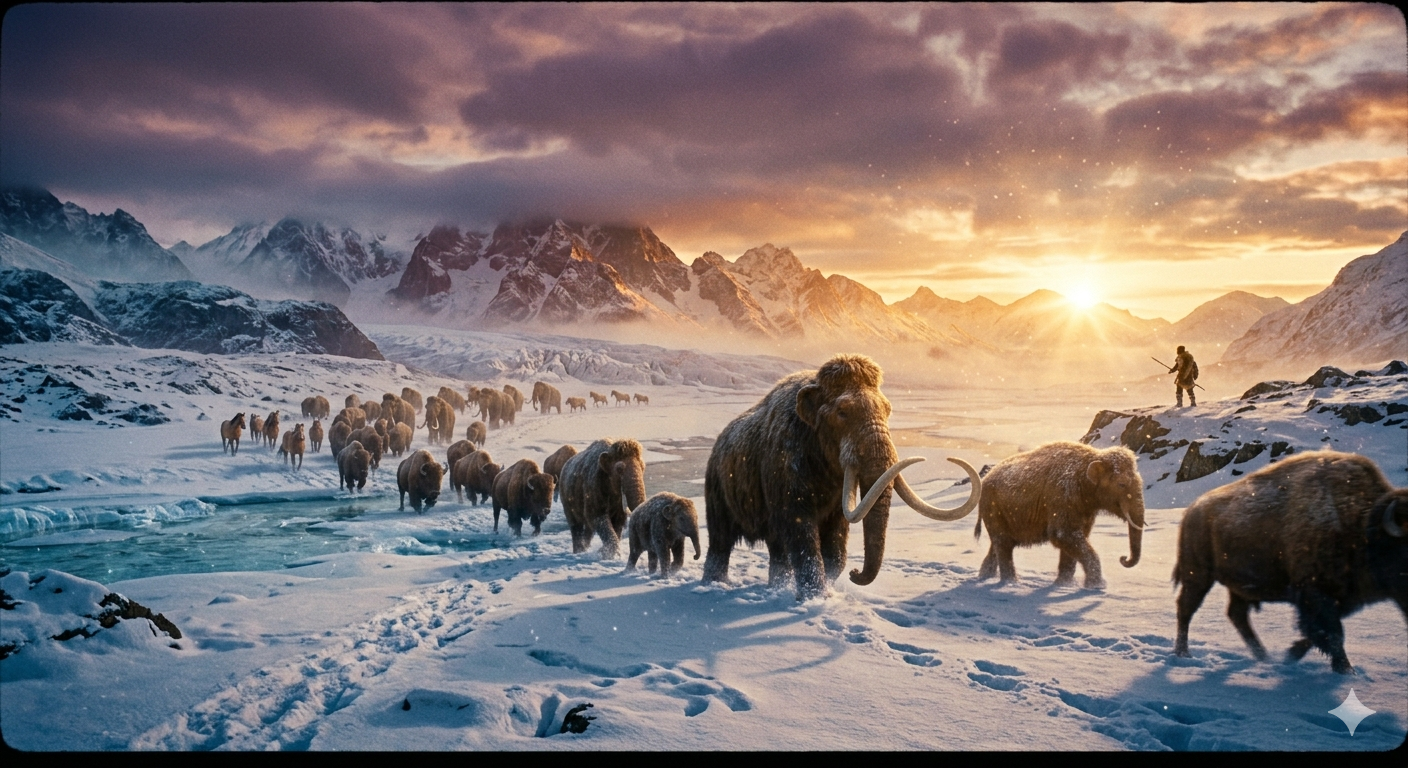
The Ice Age wasn’t triggered by brutal winters, but by something far subtler and far more powerful—cooler summers that failed to melt accumulating snow. Over time, this imbalance allowed ice sheets to expand, quietly reshaping Earth’s climate and landscapes in one of the most profound transformations in planetary history.
Introduction
Imagine a world where winter never truly ends—not because temperatures are always extreme, but because summers are simply too weak to melt the snow. Year after year, that snow accumulates, compresses, and slowly transforms into massive sheets of ice that reshape entire continents.
This is how an Ice Age begins—not with sudden freezing, but with failing summers.
The term “Ice Age” refers to long periods in Earth’s history when global temperatures dropped enough to allow large ice sheets to expand across continents. According to National Aeronautics and Space Administration, Earth has experienced multiple such glaciation periods over billions of years, each leaving a lasting imprint on the planet’s surface and climate systems (NASA, 2020; https://climate.nasa.gov).
Understanding the Ice Age isn’t just about the past—it’s about understanding how sensitive Earth’s climate truly is.
What Is an Ice Age, Really?
An Ice Age is defined as a prolonged period of cooler global temperatures during which glaciers and ice sheets persist on Earth’s surface. However, this does not mean constant freezing conditions.
Instead, Ice Ages are made up of alternating cycles—glacial periods, when ice expands, and interglacial periods, when temperatures rise and ice retreats. We are currently living in an interglacial phase known as the Holocene, part of the ongoing Quaternary Ice Age.
As explained by National Oceanic and Atmospheric Administration, these long-term cycles are influenced by variations in Earth’s orbit and climate feedback systems (NOAA, 2021; https://www.noaa.gov).
In essence, Earth’s climate behaves less like a switch and more like a slow-moving pendulum.
The Timeline: A Planetary History of Ice
Ice Ages have occurred multiple times throughout Earth’s history.
The Huronian Ice Age, around 2.4 billion years ago, is believed to have been triggered by a rise in atmospheric oxygen that altered greenhouse gas concentrations. Later, during the Cryogenian period (~720–635 million years ago), geological evidence suggests Earth may have entered a near-global glaciation phase, often referred to as “Snowball Earth” (Hoffman et al., 1998).
The current Quaternary Ice Age began approximately 2.6 million years ago. Within this period, Earth has experienced repeated glacial cycles driven by orbital variations.
During the Last Glacial Maximum, around 20,000 years ago, global temperatures were approximately 4–7°C lower than pre-industrial levels, according to assessments by the Intergovernmental Panel on Climate Change (IPCC, 2021; https://www.ipcc.ch/report/ar6/wg1/).
Human civilization emerged only after this glacial phase ended around 11,700 years ago, marking the beginning of the Holocene epoch.
The Defining Characteristics of the Ice Age
At its peak, the Ice Age dramatically reshaped Earth’s surface.
Massive ice sheets, several kilometers thick, covered large parts of North America, northern Europe, and Asia. These glaciers carved valleys, flattened landscapes, and deposited vast amounts of sediment.
Sea levels dropped by as much as 120 meters, as large volumes of water became trapped in ice sheets (NOAA, 2021). This exposed land bridges, including the Bering Land Bridge, which played a crucial role in human migration.
The climate was colder, drier, and more volatile. Dust concentrations in the atmosphere were significantly higher, and ecosystems were under constant stress.
Despite these harsh conditions, life adapted. Fossil records show that species such as woolly mammoths developed specialized traits to survive extreme cold environments (Barnosky, 2004).
Why Did the Ice Age Happen? The Critical Role of Colder Summers
One of the most important—and often overlooked—drivers of Ice Ages is the role of cooler summers.
It is not unusually cold winters that cause ice sheets to grow. Instead, it is summers that fail to melt accumulated winter snow. When summer temperatures are too low, snow persists year-round, gradually compressing into ice over thousands of years.
This process is strongly linked to Milankovitch cycles, first described by Milutin Milankovitch. These cycles involve variations in Earth’s orbit, axial tilt, and rotational wobble, which alter how solar energy is distributed across the planet (Milankovitch, 1941).
According to NASA, reduced summer solar radiation in the Northern Hemisphere is a key factor in initiating glaciation (NASA, 2020).
Additional contributing factors include:
- Lower atmospheric CO₂ levels, which weaken the greenhouse effect (Lüthi et al., 2008)
- Changes in ocean circulation that redistribute heat globally
- Ice-albedo feedback, where expanding ice reflects more sunlight and accelerates cooling
Ice core data from Antarctica shows a strong correlation between CO₂ concentrations and temperature over the past 800,000 years (EPICA Community Members, 2004; https://www.nature.com/articles/nature02599).
The conclusion is clear:
Ice Ages begin when summers are too weak to reverse winter accumulation.
Scientific Evidence: How We Know the Ice Age Happened
The Ice Age is supported by multiple, independent lines of scientific evidence.
Ice cores extracted from Greenland and Antarctica contain trapped air bubbles that preserve ancient atmospheric conditions. These cores provide direct records of temperature and greenhouse gas concentrations (EPICA Community Members, 2004).
Geological formations such as U-shaped valleys, glacial striations, and moraines offer visible evidence of past glacial movement.
Ocean sediment cores provide additional insights. By analyzing oxygen isotope ratios in marine fossils, scientists can reconstruct past ocean temperatures with high precision (Shackleton, 1967).
Together, these data sources create a consistent and reliable picture of Earth’s glacial cycles.
How the Ice Age Shaped the Earth
The impact of the Ice Age on Earth’s geography is profound and lasting.
Glaciers carved valleys, created lakes, and reshaped entire regions. The Great Lakes of North America, for example, were formed largely through glacial activity.
Climate systems were also altered. Changes in ice coverage influenced atmospheric circulation patterns and ocean currents, effects that continue to shape global climate today (IPCC, 2021).
How the Ice Age Shaped Human History
The Ice Age played a critical role in human evolution and migration.
As climates shifted, early humans adapted by developing tools, clothing, and survival strategies suited to cold environments. The exposure of land bridges enabled migration across continents, including movement into North America via the Bering Land Bridge (Goebel et al., 2008).
The end of the Ice Age brought climatic stability, which allowed agriculture to emerge. This shift marked the beginning of settled societies and, ultimately, civilization (Diamond, 1997).
Could Another Ice Age Happen?
From a scientific perspective, another Ice Age is expected—but not in the near future.
Based on orbital cycles, the next glacial period is unlikely to begin for tens of thousands of years (Berger and Loutre, 2002).
However, human activity has introduced a new variable. Rising greenhouse gas levels are increasing global temperatures at a rate that may delay or even suppress the natural cooling trend required for glaciation (IPCC, 2021).
In effect, while Ice Ages are part of Earth’s natural rhythm, human influence is now altering that rhythm.
Lessons from the Ice Age
The Ice Age demonstrates the sensitivity of Earth’s climate system.
It shows that relatively small changes—such as reduced summer temperatures—can lead to large-scale transformations over time. It also highlights the importance of adaptation, both for species survival and for long-term resilience.
Perhaps most importantly, it underscores how interconnected Earth’s systems are, from atmospheric composition to ocean circulation.
Conclusion
The Ice Age was not merely a period of extreme cold—it was a defining force that shaped Earth’s landscapes, ecosystems, and the trajectory of human history.
At its core lies a simple but powerful mechanism: when summers fail to melt winter snow, ice begins to grow. Over time, that growth transforms the planet.
Today, we face a different challenge—rapid warming rather than cooling. Yet the lessons of the Ice Age remain highly relevant.
They remind us that Earth’s climate is dynamic, sensitive, and capable of dramatic change—and that even subtle shifts can have global consequences.
References
Barnosky, A.D. (2004) Megafauna extinctions and climatic change. Cambridge: Cambridge University Press.
Berger, A. and Loutre, M.F. (2002) ‘An exceptionally long interglacial ahead?’, Science, 297(5585), pp. 1287–1288.
Diamond, J. (1997) Guns, Germs, and Steel: The Fates of Human Societies. New York: W.W. Norton & Company.
EPICA Community Members (2004) ‘Eight glacial cycles from an Antarctic ice core’, Nature, 429(6992), pp. 623–628.
Goebel, T., Waters, M.R. and O’Rourke, D.H. (2008) ‘The Late Pleistocene dispersal of modern humans in the Americas’, Science, 319(5869), pp. 1497–1502.
Hoffman, P.F., Kaufman, A.J., Halverson, G.P. and Schrag, D.P. (1998) ‘A Neoproterozoic Snowball Earth’, Science, 281(5381), pp. 1342–1346.
IPCC (2021) Climate Change 2021: The Physical Science Basis. Available at: https://www.ipcc.ch/report/ar6/wg1/ (Accessed: 25 April 2026).
Lüthi, D. et al. (2008) ‘High-resolution carbon dioxide concentration record 650,000–800,000 years before present’, Nature, 453(7193), pp. 379–382.
Milankovitch, M. (1941) Canon of Insolation and the Ice-Age Problem. Belgrade: Royal Serbian Academy.
NASA (2020) Climate Change and Ice Ages. Available at: https://climate.nasa.gov (Accessed: 25 April 2026).
NOAA (2021) Paleoclimatology Data. Available at: https://www.noaa.gov (Accessed: 25 April 2026).
Shackleton, N.J. (1967) ‘Oxygen isotope analyses and Pleistocene temperatures’, Quaternary Research, 1(1), pp. 39–55.


Leave a Reply