
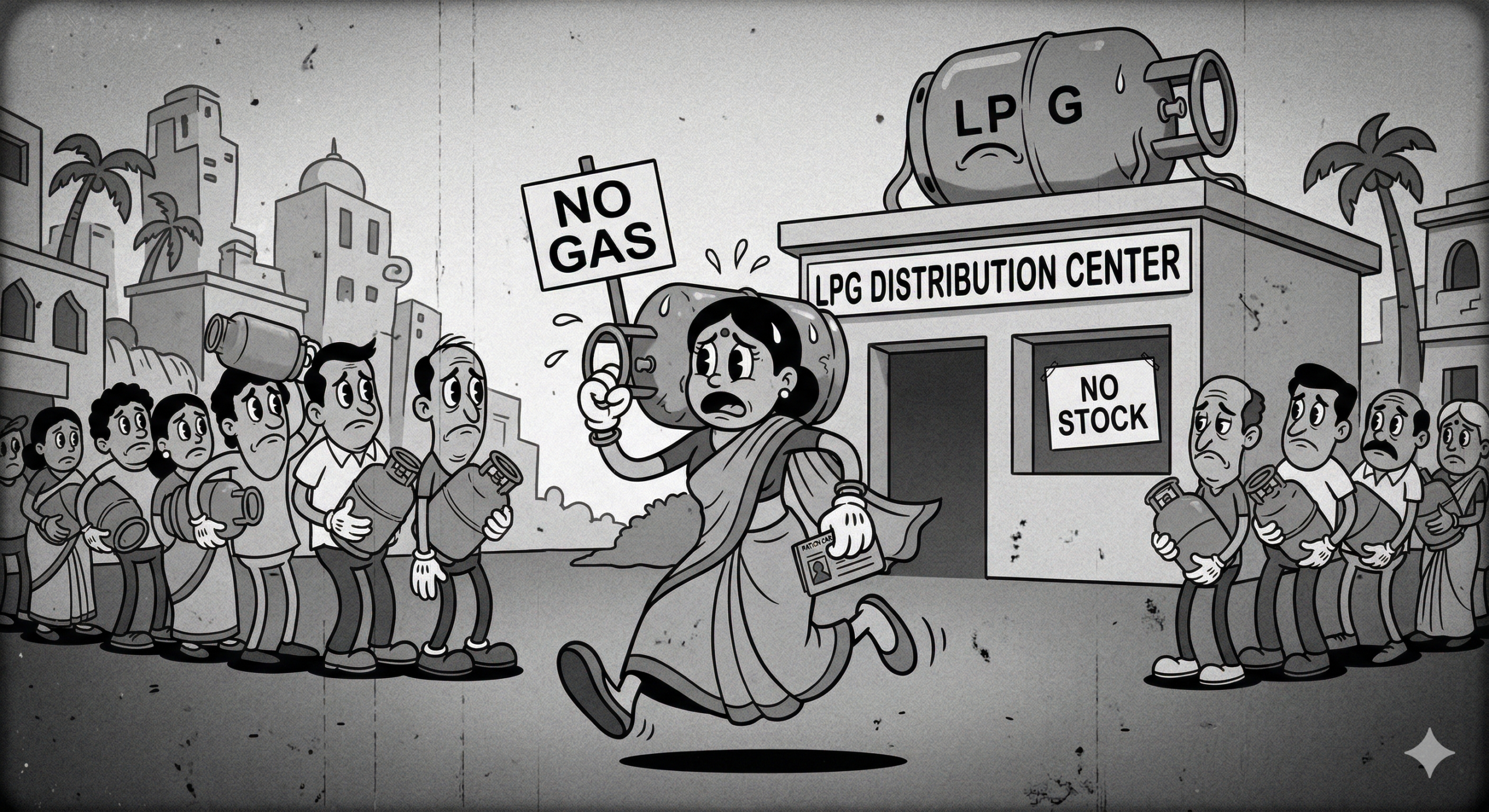
India’s LPG crisis, explained—what caused it, how we depend on the world, what China is doing differently, and what we as a country (and as individuals) can learn to build real energy security.
The Silent Flame in Every Indian Home
There is a quiet fire that burns in over 330 million Indian households.
It doesn’t make headlines. It doesn’t demand attention.
But it feeds families, sustains dignity, and powers everyday life.
That fire is LPG.
Over the past decade, schemes like Pradhan Mantri Ujjwala Yojana have transformed kitchens across India—replacing smoke-filled chulhas with clean cooking fuel.
But behind this success lies a fragile truth:
India depends on the world for most of its cooking fuel.
A Dependency We Chose—Or Ignored
India meets only about 35–40% of its LPG demand domestically.
The rest—nearly 60–65%—is imported, mostly from West Asia.
Where Does It Come From?
- Qatar → ~34%
- UAE → ~26%
- Kuwait → ~8%
- Others → Remaining share
And almost all of it passes through one narrow geopolitical artery:
Strait of Hormuz
A single disruption here doesn’t just affect trade.
It affects millions of Indian kitchens overnight.
When the System Cracked
The recent crisis wasn’t just about fuel—it was about fragility.
Escalating tensions in West Asia, particularly involving Iran, disrupted shipping routes. Tankers slowed. Supplies tightened.
India had limited buffer—barely weeks of reserves.
And suddenly:
- Cylinders became scarce
- Delivery times stretched into days
- Prices surged in informal markets
- Small businesses—street vendors, dhabas, caterers—took the hardest hit
This wasn’t just an economic issue.
It was a human disruption.
A chai seller skipping meals to save gas.
A family delaying cooking.
A worker losing income because a kitchen went cold.
Why China Stayed Steady
While India reacted, China absorbed the shock.
Not because it’s luckier.
But because it thinks differently.
What China Did Right
- Locked in long-term energy contracts
- Built massive strategic reserves
- Diversified suppliers across continents
- Invested early in infrastructure and alternatives
- Treated energy as national security—not just economics
India expanded access brilliantly.
But it didn’t build enough shock resistance.
Where India Must Go From Here
This is not a failure story.
It’s a wake-up call.
1. Diversify or Remain Vulnerable
India must reduce overdependence on one region and expand sourcing globally—even at higher short-term costs.
2. Build Strategic Reserves
A few weeks of reserves isn’t enough—we need months of well-planned buffer, not last-minute improvisation. India relies heavily on LPG imports, making it vulnerable to global price shocks and supply disruptions. Countries with stronger energy security typically maintain larger strategic reserves and diversified supply chains to cushion such risks.
3. Push Alternatives Faster
- Piped Natural Gas (PNG)
- Electric cooking
- Renewable energy integration
These must move from policy to reality.
4. Think Long-Term
Energy planning must look 20–30 years ahead, not just election cycles ahead.
But Here’s the Real Question: What Can We Do?
It’s easy to point at governments and policies.
But a nation is not just its leaders—it’s its people.
And this is where things get real.
1. Use LPG More Mindfully
- Avoid unnecessary wastage
- Cook efficiently (pressure cookers, lids, flame control)
- Small habits = national impact at scale
2. Explore Alternatives Where Possible
If you have the option:
- Shift partially to induction cooking
- Use solar cookers in rural or semi-urban areas
- Adopt PNG connections where available
This is not just about saving money—it’s about reducing pressure on the system.
3. Build Personal Buffer Habits
You don’t need to hoard—but you should plan:
- Don’t wait till the last day to refill
- Keep a backup cylinder if feasible
- Anticipate disruptions instead of reacting to them
4. Support Local and Efficient Systems
Choose:
- Local vendors who optimize delivery
- Efficient appliances
- Sustainable practices
Because resilience is not built in Delhi alone—
it’s built in every household decision.
5. Shift the Mindset: From Consumer to Contributor
This is the hardest—but most important shift.
We often think:
“Government should fix it.”
But strong nations are built when citizens think:
“How do I reduce the burden too?”
The Deeper Lesson
This crisis is not just about LPG.
It’s about how a rising nation like India handles dependence, risk, and the future.
Because growth without resilience is fragile.
And comfort without planning is temporary.
The Flame That Must Endure
That small blue flame in an Indian kitchen—
it represents more than fuel.
It represents:
- A mother cooking without smoke
- A child eating on time
- A worker earning his living
It represents dignity.
And as a nation, we must guard this flame—not by hoping for a gentler world,
but by becoming unshakable within it.
Leave a Reply