

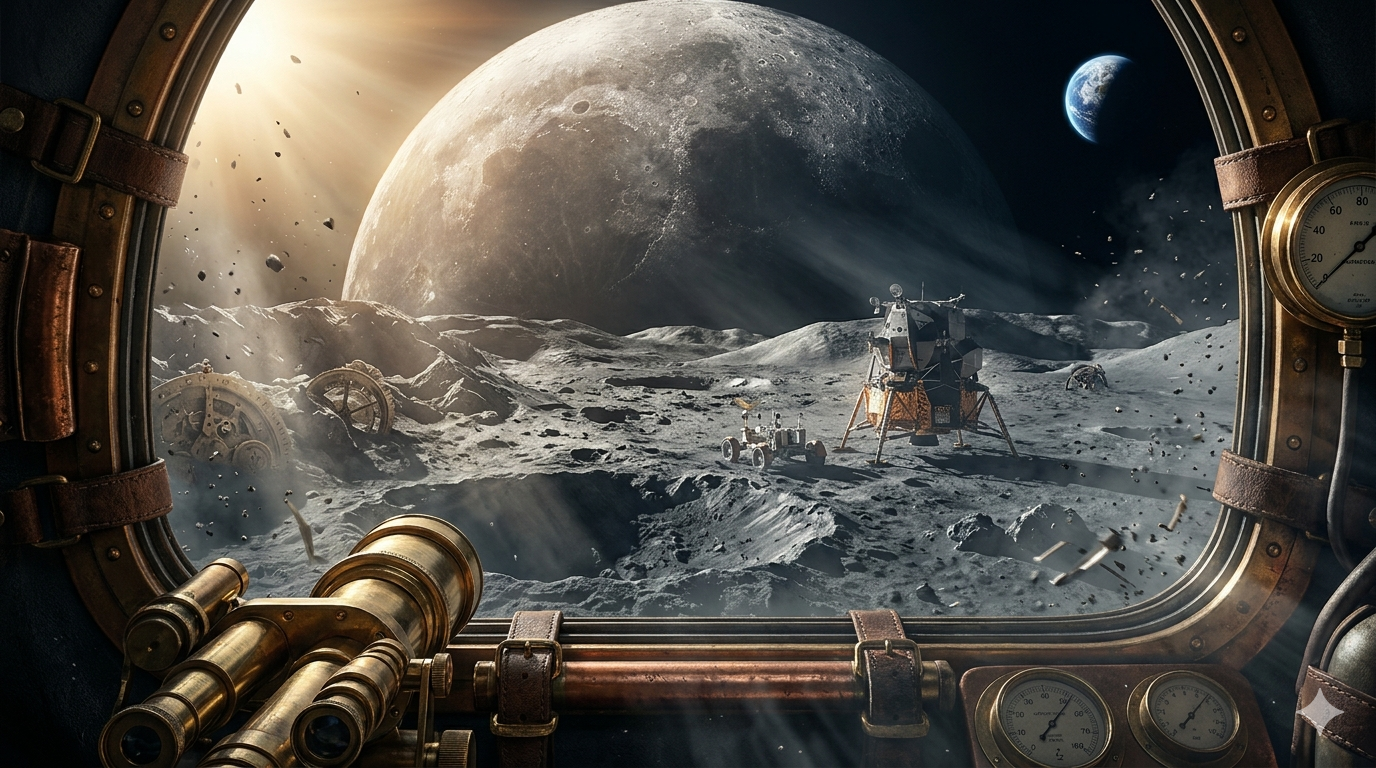
Not for glory this time—but for something far more permanent
The Silence After Apollo
In July 1969, humanity crossed a boundary it had never crossed before. When NASA successfully landed astronauts on the lunar surface during the Apollo 11 Moon Landing, the achievement was celebrated as a triumph of science and engineering. But it was also something deeper. It reshaped our understanding of what was possible. For the first time, the Moon was no longer just an object in the sky—it became a place we could reach.
Over the next few years, eleven more astronauts followed, walking on the Moon, conducting experiments, and returning safely. And then, almost as suddenly as it began, it ended. The final Apollo mission took place in 1972. Since then, no human being has set foot on the Moon.
This absence is often misunderstood. It was not because we lost the capability, nor because the Moon lost its importance. It was because the conditions that made it urgent disappeared. What followed was not failure—but silence.
Now, after more than fifty years, humanity is preparing to return. But this time, the intention is not to prove that we can go. It is to understand why we should stay.
Why Did We Stop Going to the Moon?
To understand the present, we have to confront the past honestly.
The Apollo missions were not driven purely by curiosity. They were shaped by the Cold War—a period where technological achievement was inseparable from political power. The race to the Moon was, at its core, a demonstration of capability. When the United States succeeded, the primary objective had already been fulfilled.
The financial cost was also immense. The Apollo program required an investment of approximately $25.4 billion in the 1970s, which would exceed $150 billion today. Without the geopolitical pressure to justify such spending, public interest and political will gradually declined.
As priorities shifted, so did the direction of space exploration. Focus moved closer to Earth, leading to long-term orbital projects like the International Space Station. The Moon, once central to human ambition, became a completed chapter.
But in reality, it was only paused—waiting for a different reason to matter again.
Artemis: A Different Kind of Return
The return to the Moon today is not driven by competition, but by continuity.
The Artemis program, led by NASA, represents a shift in how humanity approaches space. Named after the twin sister of Apollo, Artemis carries both symbolic and practical meaning. Where Apollo was about achieving a historic first, Artemis is about building a sustainable future.
The program has clear and ambitious objectives. It aims to return humans to the Moon, including the first woman and the first person of color, marking a more inclusive era of exploration. It seeks to establish a long-term human presence near the lunar south pole, a region believed to contain water ice. And beyond that, it positions the Moon as a testing ground for future missions to Mars.
According to NASA’s Artemis plan, the Moon is no longer the end goal. It is part of a larger journey—one that extends beyond Earth itself.
From Apollo to Artemis: A Technological Leap
The difference between Apollo and Artemis is not just time—it is capability.
Modern space exploration relies on systems far more advanced than those of the 1960s. The Space Launch System (SLS) is the most powerful rocket NASA has ever built, designed to carry heavy payloads deep into space. The Orion spacecraft is engineered specifically for long-duration missions, with improved life-support and safety systems.
A major milestone in this journey was Artemis I, launched in November 2022. This uncrewed mission successfully tested the integrated system by sending Orion around the Moon and back.
During the mission, Orion traveled more than 2.25 million kilometers—farther than any spacecraft designed for human travel has gone before. This was not just a demonstration of technology, but a signal that deep space exploration had re-entered a new phase.
Private companies are also playing a crucial role. SpaceX is developing the Human Landing System that will carry astronauts from lunar orbit to the surface. This collaboration reflects a broader transformation in how space missions are designed and executed.
The People Behind the Mission
Every mission is ultimately a human story.
Artemis represents a broader and more inclusive vision of who gets to participate in space exploration. Astronauts such as Christina Koch and Victor Glover embody this shift, representing a more diverse generation of explorers.
Beyond the astronauts, thousands of engineers, scientists, and researchers contribute to the mission. International collaboration is central to this effort, with organizations like the European Space Agency providing key components and expertise.
This is no longer a single nation’s endeavor. It is a collective project—one that reflects a shared human ambition rather than a competitive race.
India’s Quiet but Powerful Role
While Artemis is led by NASA, the global landscape of space exploration has evolved significantly. India has emerged as one of the most important contributors to this new era.
The ISRO achieved a historic milestone with Chandrayaan-3, successfully landing near the Moon’s south pole in August 2023. This region is of particular interest due to the potential presence of water ice.
The implications of this discovery are profound. Water can be separated into hydrogen and oxygen, providing both fuel and breathable air. This makes long-term habitation on the Moon significantly more feasible and reduces dependence on Earth-based resources.
India’s participation in the Artemis Accords further strengthens its role in shaping the future of lunar exploration. Rather than operating independently, nations are increasingly collaborating, recognizing that the challenges of deep space require shared effort and knowledge.
The Moon Is Not as Silent as It Looks
The Moon often appears calm and unchanging, but its reality is far more dynamic.
It is slowly drifting away from Earth at a rate of approximately 3.8 centimeters per year. Over vast periods of time, this movement will alter Earth’s tides and even the length of our days. The connection between Earth and the Moon is not static—it is evolving.
The Moon also experiences seismic activity known as moonquakes. Unlike earthquakes, which dissipate relatively quickly, moonquakes can last for extended periods because the Moon’s interior does not absorb vibrations efficiently. Instead, it resonates, almost like a bell.
Lunar dust presents another unexpected challenge. During the Apollo missions, astronauts found that the fine particles clung to their suits and caused irritation when inhaled. At a microscopic level, this dust is sharp and chemically reactive, making it a serious concern for long-term missions.
Perhaps most striking is the way the Moon preserves history. With no atmosphere, no wind, and no water, footprints left decades ago remain intact. The marks of human presence do not fade—they endure.
Debunking the Myths Around Moon Landings
Skepticism surrounding the Moon landings has persisted for decades, often fueled by misunderstandings rather than evidence.
One common claim is that the American flag appears to wave, suggesting the presence of wind. In reality, the motion was caused by the force used to place the flag into the ground. Without air resistance, the movement continued longer than it would on Earth, creating the illusion of waving. The flag’s design, which included a horizontal support rod, also contributed to its extended appearance.
Another argument concerns the absence of stars in lunar photographs. This can be explained by camera exposure settings. The lunar surface, illuminated by direct sunlight, is extremely bright. Cameras were adjusted to capture this brightness, making faint objects like stars invisible in the images.
Some have pointed to shadows that appear to fall in different directions as evidence of multiple light sources. However, this effect can be explained by uneven terrain and perspective. On a surface with varying elevations, shadows can appear distorted, even when there is only a single light source—the Sun.
The most compelling evidence comes from physical data. The Apollo missions returned 382 kilograms of lunar rock, which have been studied by scientists worldwide. These samples have unique chemical compositions that cannot be replicated on Earth.
Additionally, retroreflectors placed on the Moon during the Apollo missions are still used today. Scientists regularly bounce lasers off these devices to measure the distance between Earth and the Moon with extraordinary precision. This ongoing experiment provides continuous, verifiable evidence of human activity on the lunar surface.
It is also important to note that Apollo missions were tracked independently by multiple countries, including those that were not aligned with the United States during the Cold War. The idea of a global conspiracy involving thousands of scientists across competing nations is not just unlikely—it is implausible.
Why the Moon Matters More Than Ever
The renewed focus on the Moon is driven by both necessity and opportunity.
The lunar south pole has become a key target because of its potential reserves of water ice. These resources could support long-term human presence and enable the production of fuel for deeper space missions.
The Moon also offers a strategic advantage as a testing ground. Its proximity to Earth allows for shorter missions and quicker responses in case of emergencies. Technologies developed and tested on the Moon can later be applied to missions to Mars and beyond.
In this sense, the Moon is not just a destination—it is a foundation.
The Deeper Question: What Are We Really Doing?
Beyond the science and strategy lies a more complex question.
Returning to the Moon forces us to reflect on the nature of exploration itself. Who will have access to space? How will resources be managed? Will the inequalities that exist on Earth be carried into space?
Space exploration has always been as much about humanity as it is about technology. The decisions we make now will shape not just our presence on the Moon, but the kind of civilization we become beyond Earth.
Conclusion: A Return With Purpose
The Moon we are returning to has not changed, but we have.
The Apollo missions were driven by urgency and competition. Artemis is driven by intention and sustainability. It marks a transition from exploration to habitation, from symbolic achievement to long-term vision.
The next human steps on the Moon will not simply repeat history. They will begin a new chapter—one that extends the boundaries of human presence beyond Earth.
And perhaps, in that quiet and distant landscape, we will find not just new knowledge, but a clearer understanding of ourselves.

Leave a Reply